
AI Marketing Tools for Email Marketing: The Complete 2026 Guide
Email is now the most heavily AI-augmented channel in the marketing stack — AI writes the subject line, decides who gets which message, picks the send time, and predicts who is about to churn, often inside the platform a team already uses. Most of these capabilities ship inside dedicated AI marketing tools rather than one standalone email bot.

The practical question is not «which AI email tool is best,» but which tool fits each job — writing, sending, segmenting, or analyzing — and each budget. Email marketing itself is decades old; what changed is how much of the work AI now automates. This guide breaks the market into working categories with real 2026 pricing.
How AI Is Reshaping Email Marketing
Email volume is enormous, so manual optimization can’t keep pace with it — AI is leverage for a lean team, not a replacement for strategy.
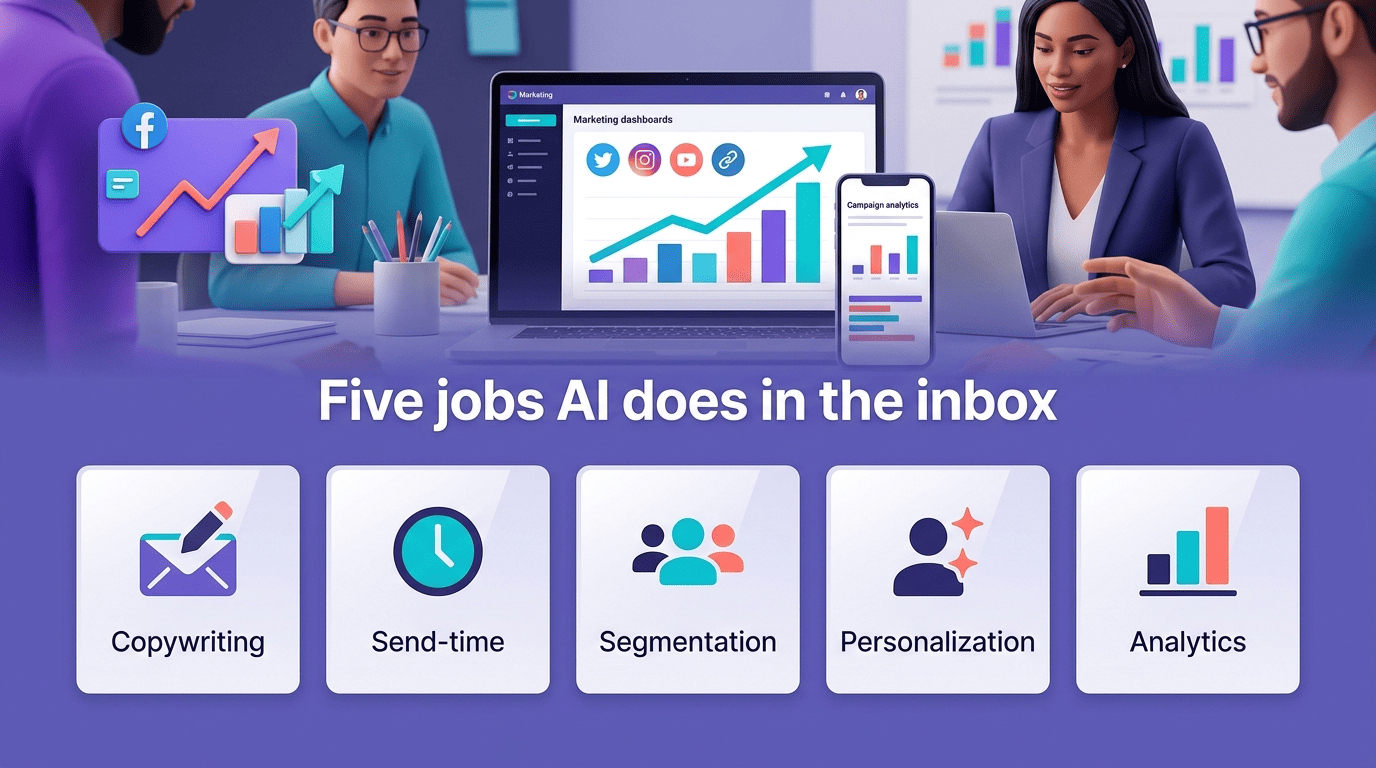
The five jobs AI does in an inbox
AI in email marketing generally handles five distinct functions:
- Copywriting and subject lines — drafting body copy and generating subject-line variants
- Send-time optimization / predictive sending — learning each contact’s likely open window
- Segmentation and list hygiene — grouping contacts and flagging inactive or risky addresses
- Personalization and dynamic content — swapping images, offers, or copy blocks per recipient
- Analytics and churn prediction — scoring engagement and flagging subscribers about to disengage
Adoption is mainstream: roughly 63% of marketers report using AI tools in email marketing, and research from McKinsey & Company found that personalization most often drives a 10-15% revenue lift, with company-specific results ranging from 5% to 25% depending on sector and execution. McKinsey’s report on the topic put the growth gap directly:
«Fast-growing companies drive 40 percent more of their revenue from personalization than their slower-growing counterparts.»
McKinsey & Company
Why it matters now
According to Mailchimp’s own definition, email marketing is a form of direct and digital marketing that uses email to promote a business’s products or services — and AI email software simply automates or accelerates parts of that existing workflow rather than replacing it. Large senders now move an enormous share of global commercial mail through automated pipelines, which is precisely why hand-tuned send times and manually written subject lines no longer scale for teams running more than a handful of campaigns a month.
Best AI Tools for Writing Emails & Subject Lines
Generative copy tools split into two groups: general-purpose AI writers built into most platforms, and specialist engines built only for subject lines and send-optimized language.
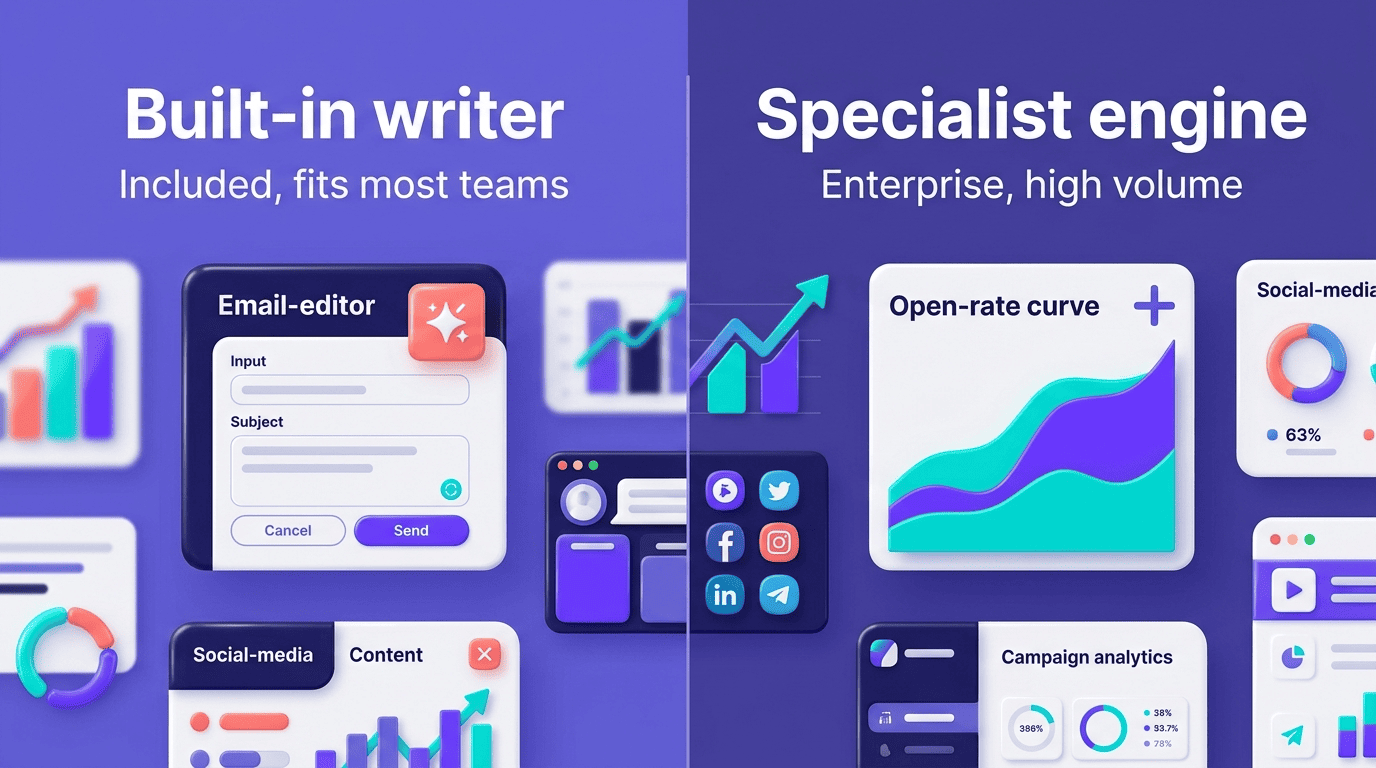
Generative copy and subject-line optimizers
Jasper generates on-brand email copy at scale from a Brand Voice profile, making it a fit for teams that already have a style guide to feed it. Phrasee (now folded into the Jacquard platform) and Persado specialize in AI-generated, brand-safe language optimized specifically to lift opens and clicks, and both price for enterprise budgets rather than solo marketers. MailerLite’s built-in AI writer supports 30+ languages, which matters for any team sending to more than one market from a single account.
| Tool | Best for | Starting price |
|---|---|---|
| Jasper | On-brand copy at scale | ~$59/mo |
| Phrasee / Jacquard | Brand-safe subject-line optimization | ~$24,000/yr |
| Persado | Enterprise language optimization | ~$500/mo, scaling into six figures/yr |
| MailerLite AI | Multi-language copy, small teams | Free tier, then ~$12/mo |
When a copy specialist beats a built-in writer
Most all-in-one platforms now ship a basic AI writer as a standard feature, so a dedicated copy engine like Phrasee or Persado only earns its premium at high send volume, where even a 1-2% open-rate lift is worth thousands of dollars a month. Below that volume, the built-in generator inside a platform like Mailchimp or Brevo typically covers the job without a separate contract.
Best All-in-One AI Email Platforms
The major platforms in this category — ActiveCampaign, Mailchimp, Brevo, GetResponse, Klaviyo, and HubSpot — all package AI copywriting and predictive sending as standard features rather than paid add-ons, which is the main reason most small teams start here instead of buying a specialist tool first.
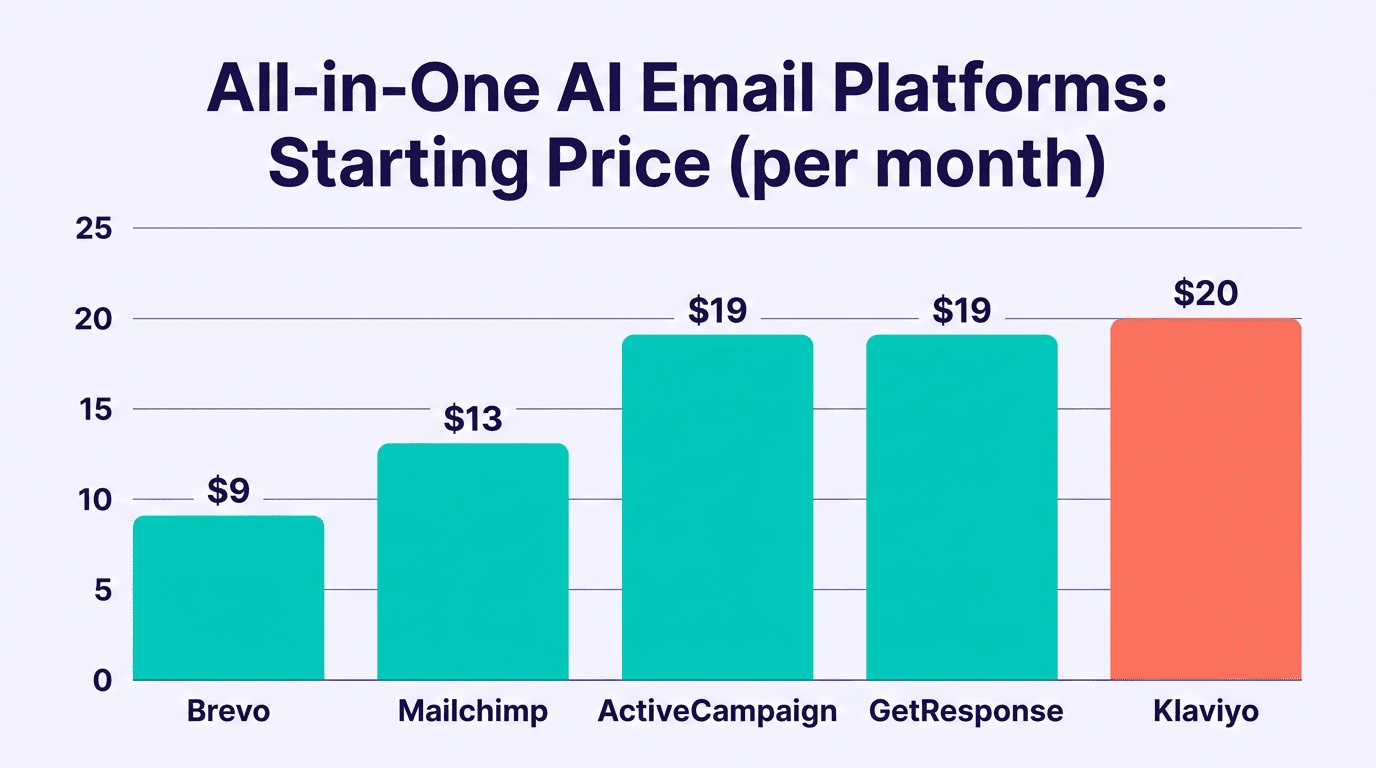
Platforms that bundle every job
ActiveCampaign combines AI content generation, Predictive Sending, and a wide library of automation triggers; independent deliverability tests have put its inbox placement well above the industry average, though results vary by testing methodology and volume. Brevo bundles email, SMS, and WhatsApp with AI subject-line help and best-time sending, and it keeps a usable free tier. GetResponse offers AI email and course generation alongside its Perfect Timing send-time optimization feature. Klaviyo leads for ecommerce with predictive analytics and product recommendations built around purchase history. Mailchimp and HubSpot’s Breeze AI round out the mainstream options — HubSpot’s Marketing Hub starts near $9 per seat on its entry tier but climbs to several hundred dollars a month once a team needs the Professional or Enterprise tier, plus a one-time onboarding fee.
| Platform | Best for | Key AI feature | Starting price |
|---|---|---|---|
| ActiveCampaign | Automation-heavy teams | Predictive Sending | ~$19/mo |
| Mailchimp | Small business, general use | AI copy assistant | ~$13/mo |
| Brevo | Multi-channel, budget-conscious | AI subject lines + best-time sending | Free, then ~$9/mo |
| GetResponse | Course creators, content teams | Perfect Timing | ~$19/mo |
| Klaviyo | Ecommerce | Predictive analytics | ~$20/mo |
| HubSpot | B2B pipeline attribution | Breeze AI | $9/seat/mo entry, $3,600+/mo Enterprise |
Pricing at a glance
AI email pricing tends to fall into three bands:
- Entry — $9-19/month, usually capped on contacts, sends, or AI credits
- Mid-tier — $50-100/month, higher sending limits and more AI automation
- Enterprise — $150 to over $1,600/month, scaled to contact volume and seats
Free tiers exist at Brevo, Mailchimp, and MailerLite, but each one caps contacts, monthly sends, or AI credits.
Best AI Tools for Send-Time & Deliverability
Send-time and deliverability tools work upstream of copy — they decide when a message goes out and whether it reaches the inbox at all, which matters more than subject-line wording once volume climbs.
Predictive send-time engines model each contact individually. Seventh Sense builds a per-contact send-time profile on top of an existing HubSpot or Marketo account, starting around $80 per month for HubSpot and closer to $450 per month for Marketo. ActiveCampaign’s Predictive Sending and GetResponse’s Perfect Timing feature — which launched back in 2015, well before the current wave of generative AI tools — do the same job natively inside their own platforms rather than as an add-on integration.
Deliverability tools protect sender reputation. AI-based bot-open and bot-click detection, spam-trigger scoring, and automatic list cleanup keep bounce rates and complaint rates down, which in turn keeps a domain out of inbox providers’ spam filters. Not every large sender has native AI deliverability tooling; some of the biggest infrastructure providers rely on third-party integrations layered on top instead of building the feature in-house.
How to Choose the Right AI Email Tool
Choosing well starts with the job, not the brand — an AI marketing assistant is only useful once it’s matched to what a team actually needs automated first.
Match the tool to your team and goal
- Solo senders and SMBs — Brevo, Mailchimp, or MailerLite ($0-19/mo) cover copy, basic segmentation, and send-time help without a long contract
- Ecommerce teams — Klaviyo or Omnisend for product-recommendation AI tied directly to purchase and browsing history
- B2B teams — platforms with strong intent and pipeline attribution, since email alone rarely closes a deal without CRM context
- High-volume senders — a specialist like Phrasee, Persado, or Seventh Sense layered on top of an existing platform, once the volume justifies the price
A good AI marketing assistant fits the job first; only then is it worth comparing brands within that category. Many teams end up combining several tools built on generative AI for marketing rather than expecting a single subscription to cover writing, sending, and analytics equally well.
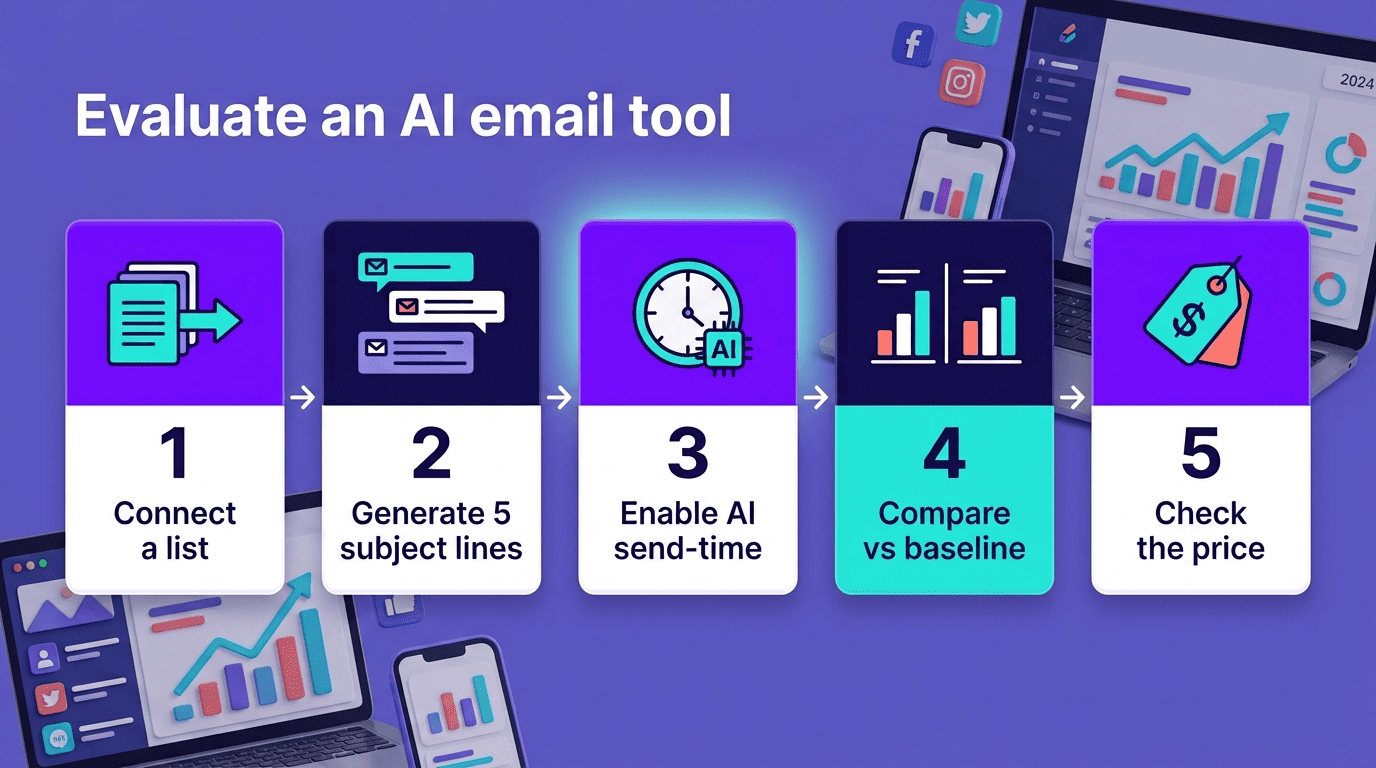
A short evaluation checklist
- Connect one existing contact list to the tool’s free tier
- Generate five subject-line variants for a real campaign
- Enable predictive or AI-recommended send-time for that campaign
- Run the campaign and compare open and click rates against a manual baseline over two weeks
- Check the per-contact price at the tier the team will actually need before committing to a paid plan
Best Practices & Risks
AI drafts, humans approve — that division of labor is what keeps AI-assisted email safe to send at scale.
Keep a human in the loop
Every AI-generated email should get a human review pass before it sends: checking for brand voice, factual accuracy, and any claim the AI may have invented outright (a known hallucination risk in generative text). Disclose AI-assisted content where a platform or regulation requires it, and never send a fully unreviewed AI draft to a live list. On the data side, subscriber information is only as safe as the tools it’s shared with — confirm what a vendor does with contact data before connecting a list, and check the tool’s compliance posture against frameworks like the EU’s General Data Protection Regulation and US state-level privacy laws such as the CCPA.
Related AI marketing tool guides
Building a full stack? Explore AI analytics and reporting tools and AI content creation tools to round out your workflow across the marketing funnel.