
AI Marketing Tools for Content Creation: The 2026 Playbook for Faster, On-Brand Content
Content used to be the bottleneck of every marketing team — now it is the fastest-moving part of the funnel. The right AI marketing tools let a small team draft, design, and ship a blog post, ad, or short video in the time it once took to brief a freelancer.
Most of these platforms are powered by the same underlying technology — generative artificial intelligence and large language models — so the real question is not «which model,» but «which tool for which job.» This guide breaks down what AI content tools actually do, the categories that matter, and the specific tools (with prices) marketers rely on in 2026, plus a workflow to use them without wrecking quality.
What Are AI Marketing Tools for Content Creation?
AI content creation is the use of artificial intelligence — specifically large language models (LLMs) and generative AI — to plan, draft, repurpose, and optimize content across formats: blog posts, social media, email, ad copy, and video scripts. General assistants like ChatGPT and Claude, and marketing-specific writers like Jasper, all sit on top of the same LLM foundation; the differences are in workflow, brand controls, and integrations.
Why marketers adopted it so fast
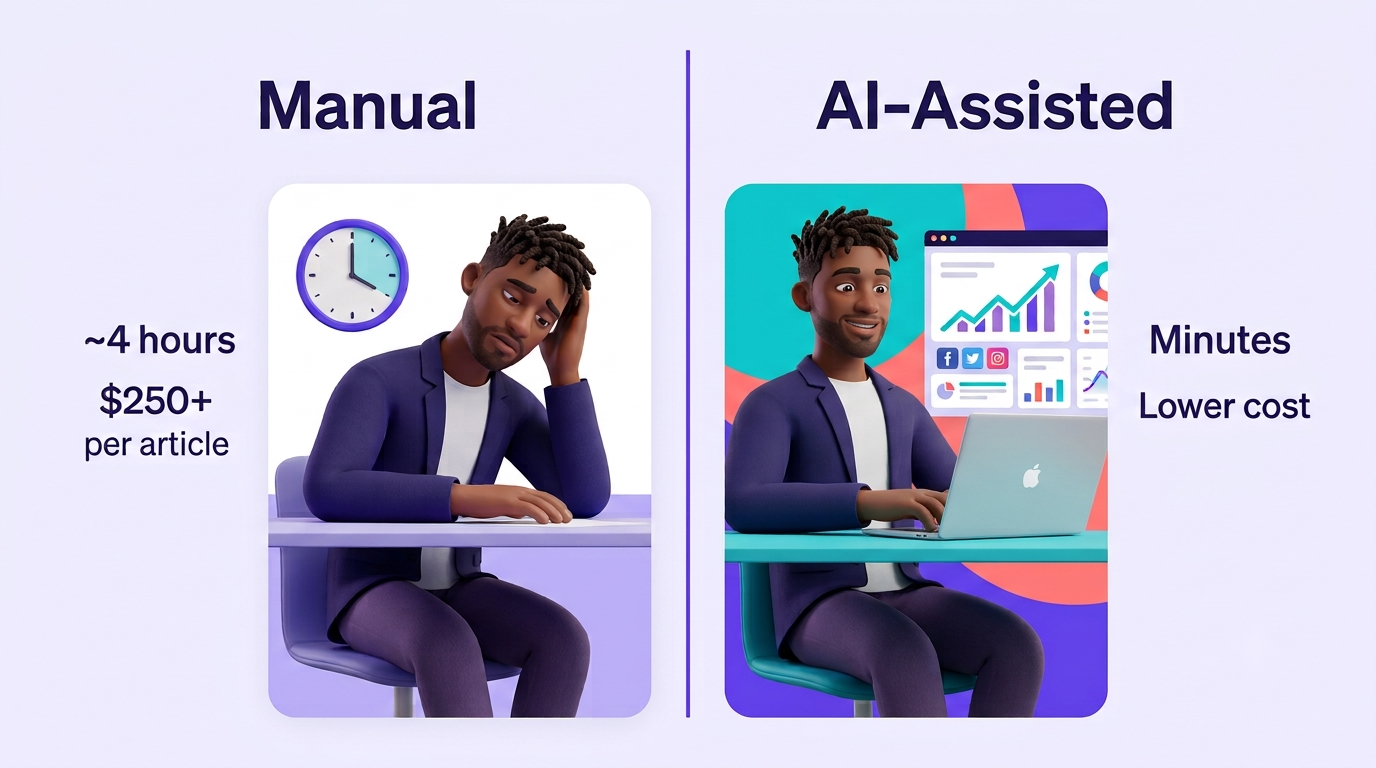
The pull is economic, not just novelty. More than 75% of marketers now use AI tools to some degree, and among them, 44% specifically use AI to write content drafts. The math is simple: a typical blog post takes about four hours to write manually, and outsourcing a 1,500-word article commonly runs $250 or more. AI content generators collapse both the time and the cost — which is why AI marketing software moved from experiment to default in barely two years.
The Main Categories of AI Content Tools
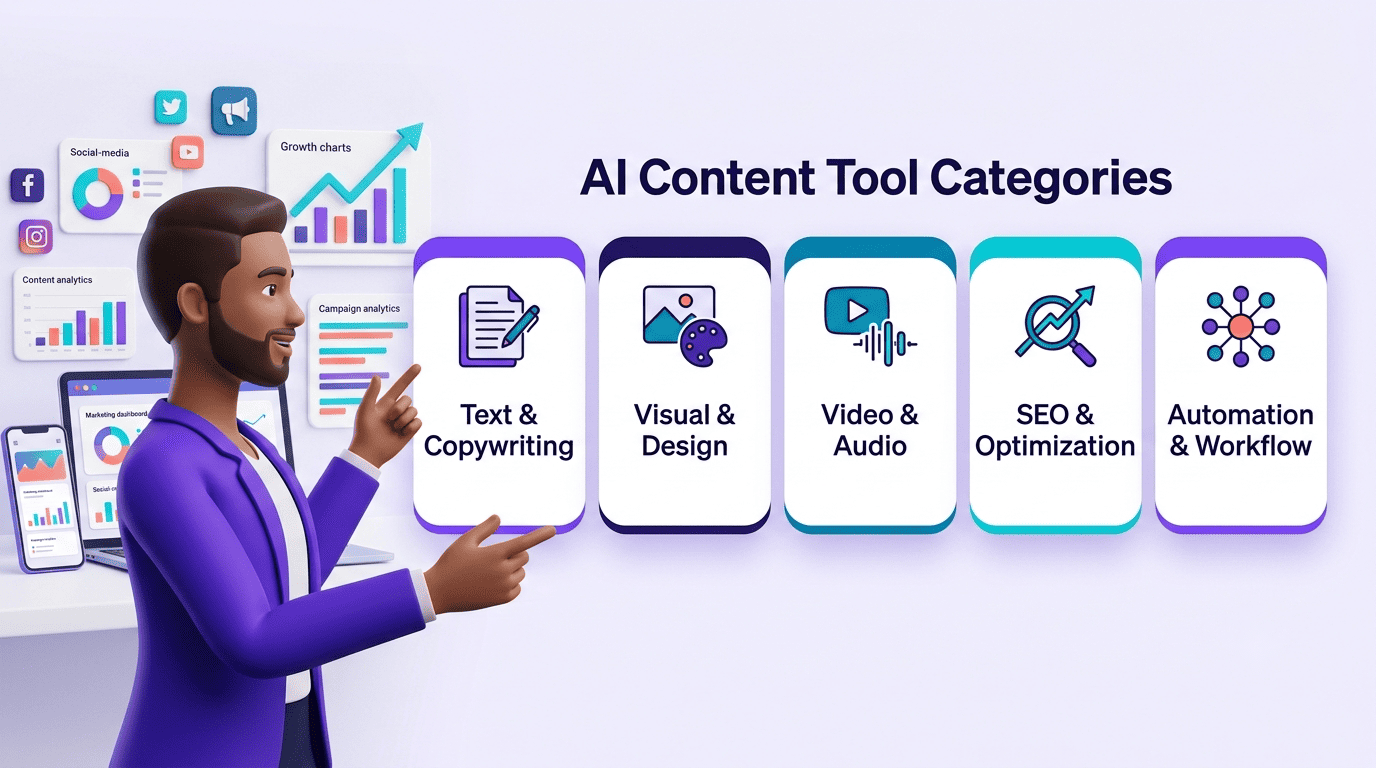
There is no single «best» tool, because content creation is really five jobs. Marketers assemble a small stack — one tool per category — rather than hunting for one platform that does everything.
| Category | What it does | Representative tools |
|---|---|---|
| Text & copywriting | Blogs, emails, ad copy | ChatGPT, Claude, Jasper, Copy.ai, Writer |
| Visual & design | Graphics, social posts, decks | Canva |
| Video & audio | AI video, editing, voiceover | Synthesia, Descript, Pictory, ElevenLabs |
| SEO & optimization | Briefs, on-page, AI visibility | Surfer SEO, Frase, Semrush |
| Automation & workflow | Connect tools, publish | Zapier, Notion AI |
Text, visual, and video
For writing, LLM assistants (ChatGPT, Claude) and marketing-specific writers (Jasper, Copy.ai, Writer) cover blogs, emails, and ad copy. For design, Canva turns copy into on-brand graphics and social posts from a library of more than 1.6 million templates. For rich media, Synthesia generates AI-avatar video in more than 160 languages, Descript and Pictory repurpose long content into clips, and ElevenLabs provides voiceover from a bank of over 10,000 voices.
SEO and automation
On the optimization side, Surfer SEO, Frase, and Semrush build briefs, score on-page content, and track how often your brand appears in AI answers. The glue is automation: Zapier connects more than 9,000 apps, so a finished draft can flow from your writer to your CMS to your social scheduler without copy-paste.
Best AI Tools for Content Creation by Task (with Pricing)
Pricing below reflects published entry plans as of 2026; most vendors also sell higher enterprise tiers.
| Task | Tool | Entry price | Why it stands out |
|---|---|---|---|
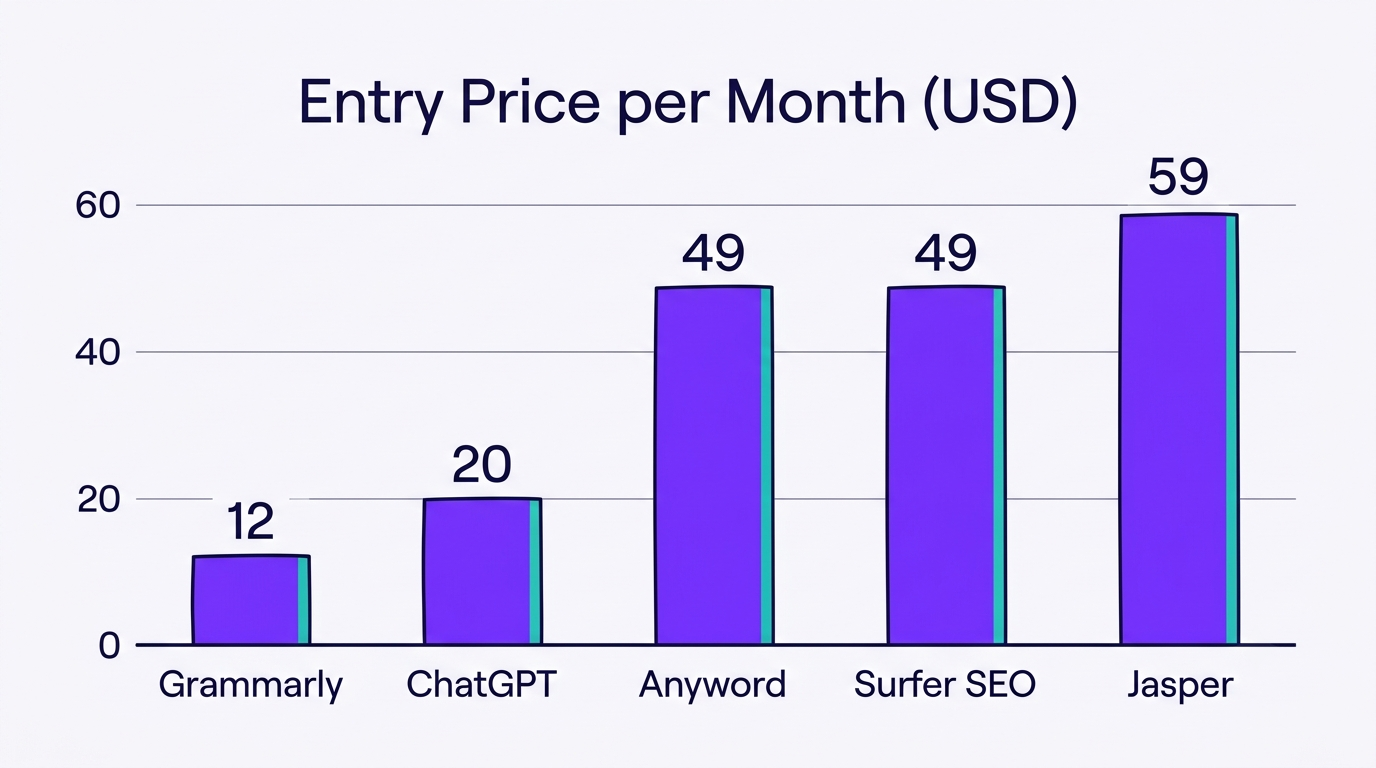
| Long-form, on-brand | Jasper | from ~$59–69/mo | 4.7/5 across 1,270 G2 reviews |
| General drafting | ChatGPT | $20/mo (Plus) | Flexible workhorse for outlines, rewrites |
| Editing & brand voice | Grammarly | $12/mo (annual) | 40M users, 50,000+ organizations |
| Conversion copy | Anyword | from ~$49/mo | 82% predictive accuracy vs 52% generic |
| SEO content | Surfer SEO | $49–299/mo | On-page optimization scoring |
| Visual content | Canva | from ~$12/mo (Pro, annual) | On-brand graphics and social at scale |
Writing and editing
For long-form content that has to match a brand voice, Jasper is the safest pick for marketing teams. For everyday drafting, outlines, and rewrites, ChatGPT Plus ($20/mo) and Claude are the flexible workhorses. Before anything ships, Grammarly (Premium $12/mo billed annually) catches errors and enforces tone across a claimed 40 million users and more than 50,000 organizations.
Predictive copy is where AI pulls ahead of guesswork. Anyword scores draft variations on likely performance with 82% accuracy, versus 52% for generic AI output — a meaningful edge on ad headlines and landing-page copy where small lifts compound.
SEO and visuals
For search, Surfer SEO ($49–$299/mo) and Koala AI turn a keyword into an optimized draft, with some tools producing 3,500-plus-word articles in a single pass. For design, Canva Pro (from ~$12/mo billed annually, $15+/mo billed monthly) converts a paragraph of copy into on-brand graphics, presentations, and social posts — closing the gap between «written» and «published.»
How to Create Content with AI: A Practical Workflow
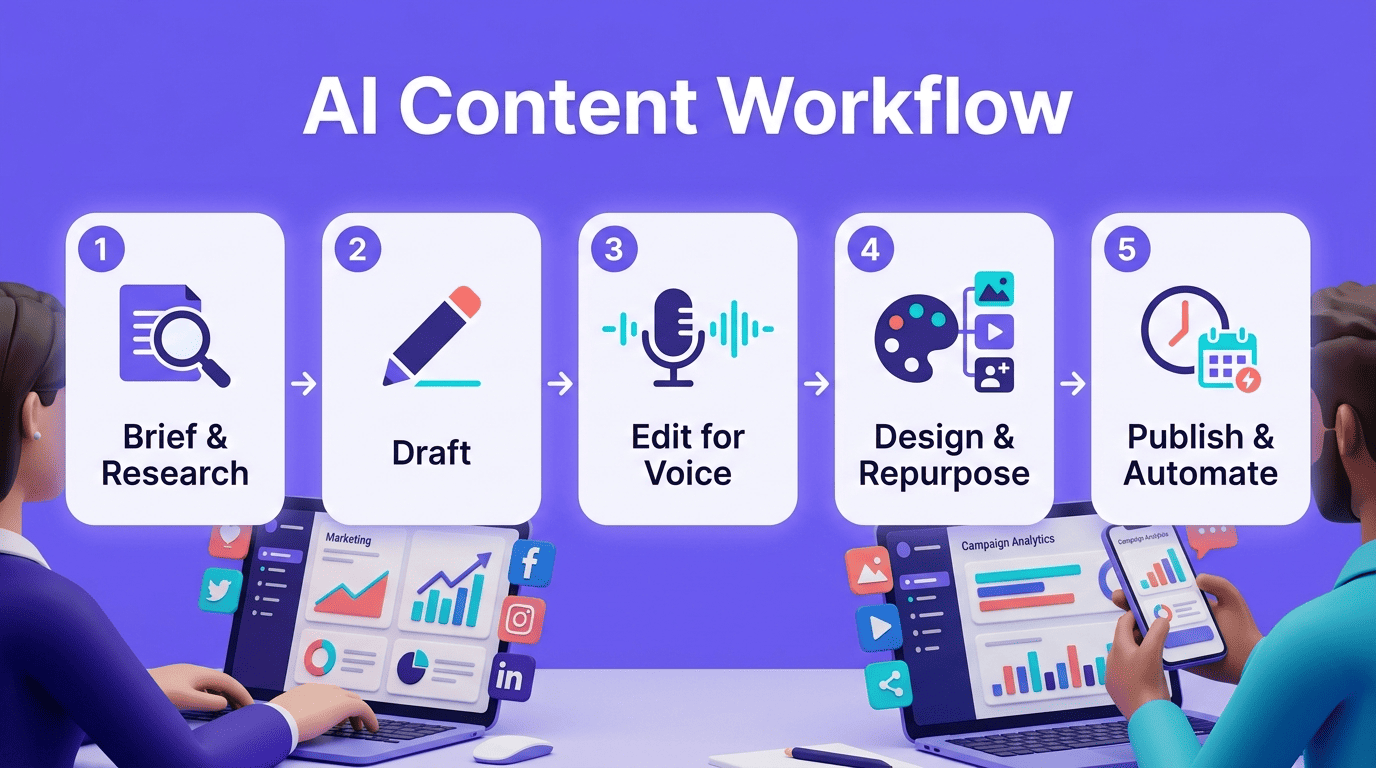
Tools do not make content good; process does. The teams getting real leverage follow a repeatable loop rather than typing a single prompt and hitting publish.
- Brief and research. Use an LLM plus Surfer or Frase to build the outline and target entities.
- Draft. Generate a first pass with Jasper or Copy.ai — a 2,000-to-2,900-word post lands in 12 to 20 minutes.
- Edit for accuracy and voice. Run Grammarly, then a human editor, over every claim and every sentence.
- Design and repurpose. Turn the piece into graphics (Canva) and clips (Descript).
- Publish and automate. Push it live and syndicate through Zapier.
The speed is real: VertoDigital documented cutting content production time from five-to-eight hours down to one-to-three hours per piece using Jasper, and Adidas generated 7,500 product descriptions in 24 hours using the same platform.
The non-negotiable step: human oversight
Speed is worthless if the output is wrong or generic. AI provides efficiency but does not replace human strategy and originality, so every draft needs editorial review for factual accuracy, brand fit, and a point of view a competitor could not have written.
Benefits and Limits of AI Content Tools
The upside is straightforward: speed, cost savings, scalability, and more consistent SEO output across a larger content calendar. The limits are just as real — factual errors (hallucinations), a flat generic tone, and legitimate concerns about originality and AI detection.

The ranking question worries marketers most, and Google has been explicit that method of production is not the issue.
Our focus on the quality of content, rather than how content is produced, is a useful guide that has helped us deliver reliable, high quality results to users for years.
Google Search Central
In practice, that means AI-assisted content ranks fine when it is genuinely helpful and people-first — and gets filtered out when it is thin, unedited, and indistinguishable from every other AI draft. The tool is an accelerator, not a substitute for judgment.
Related AI marketing tool guides
Building a full stack? Explore AI tools for graphic design and images and AI social media marketing tools to round out your workflow across the marketing funnel.